
Marriage as a Promised Escape
Unorthodox: The Scandalous Rejection of My Hasidic RootsDevorah enters an arranged marriage hoping that it will bring adulthood and independence, but the realities of sexual expectations, family interference, and religious control turn that hope into a prolonged crisis.
increasing Bearing strength in each event
 decreasing
Bearing strength in each eventdecreasingA Match Is Set

A Future Chosen by Others
Becoming a marriage prospect
As Devorah succeeds at work, her family begins arranging a match. She understands that her appearance, family reputation, and religious standing are being assessed, yet she has little access to the conversations shaping her future.
When she meets Eli, she tries to learn whether he has opinions of his own and whether he might accept her independent nature. His assurances give her hope, but the meeting is brief and the decision is still embedded in family expectations.
Hope mixed with constraint
Devorah agrees to the engagement in a setting where refusal feels almost impossible. The celebration brings attention and expensive gifts, temporarily making her feel valued, while also showing how the arrangement is being shaped around an ideal bride she does not fully recognize as herself.
She imagines marriage as a possible route to freedom: a home of her own and perhaps a partner who will share her curiosity. That hope becomes the emotional wager she carries into the wedding.
Lessons About Her Body
Preparation Under Pressure
Rules of marriage
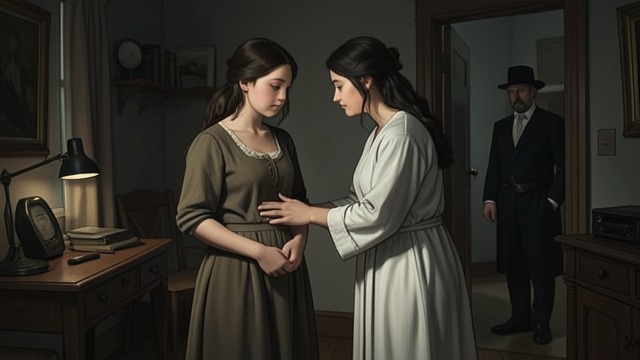
Marriage lessons introduce Devorah to the laws of menstruation, ritual purity, and sexual intimacy in an atmosphere that leaves her both curious and ashamed. The instruction frames her body chiefly in relation to religious rules and her future husband’s access to it.
Devorah has scarcely been encouraged to understand her own anatomy. During a lesson about sexual intercourse, she becomes convinced that she may lack the body part being described, and the discovery that she does not brings shock rather than reassurance.
An unfamiliar threshold
The episode makes the distance between her inner life and her expected marital role impossible to ignore. She has been raised to avoid awareness of her body, then is abruptly expected to prepare it for marriage.
The mikvah becomes another test of submission. At her first immersion, an attendant insists on inspecting her in a way Devorah finds humiliating, leaving her to conceal distress behind an appearance of composure.
A Wedding and a Failure

The Marriage Begins
Public ceremony
Devorah and Eli marry in a traditional ceremony that places her at the center of an elaborate public celebration while leaving her privately unsure of what the new relationship requires. The ceremonial clothing, customs, and family attention turn the day into a performance of a role she has not had the freedom to define.
After the celebration, the couple is alone for the first time. Neither has adequate knowledge or ease, and their attempt at intercourse fails, making the anticipated beginning of married life feel uncertain from the outset.
Private difficulty becomes public
Instead of being treated as a private matter for the newlyweds, the failure quickly reaches Eli’s family. Devorah is horrified that a personal difficulty can become subject to family scrutiny and neighborhood gossip.
Pressure to succeed intensifies the problem rather than easing it. Devorah’s bodily fear, their inexperience, and the expectation that the marriage must be consummated combine to turn intimacy into a test she feels she is failing.
A Marriage Under Examination
Intimacy Becomes a Crisis
Searching for a cause
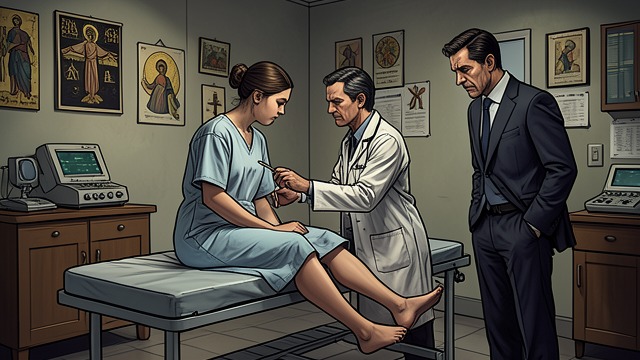
Repeated attempts at intercourse leave Devorah and Eli distressed and exposed to the opinions of relatives and religious authorities. Doctors raise the possibility of a physical problem, while the couple’s sexual inexperience and Devorah’s fear remain difficult to separate from medical explanations.
The failure affects more than their sex life. Devorah feels judged by a community that treats consummation as proof of marital success, while Eli struggles with anxiety and turns to his family for guidance.
The relationship frays
Devorah undergoes medical consultations and learns that vaginismus may be involved. The diagnosis gives her language for the body’s involuntary response, but understanding the mechanism does not immediately remove the shame or emotional strain surrounding it.
When Eli leaves home after family pressure, Devorah experiences the departure as betrayal. He later returns, but the episode deepens her distrust and makes it harder to believe that marriage will provide the security or partnership she had imagined.
Consummation and Pregnancy

A Painful Milestone
A medical strategy
Devorah follows exercises intended to address vaginismus, working through a process that is physically difficult and emotionally isolating. After months of effort, she and Eli finally have intercourse, but the event brings relief at having crossed a threshold more than any clear sense of mutual intimacy.
Eli experiences the moment as a breakthrough, while Devorah remains unsure what it means for her own pleasure or their relationship. The asymmetry continues to trouble her even as others treat the consummation as the solution to their problems.
A new responsibility
Soon afterward, Devorah discovers she is pregnant. She turns to practical preparation and reading, trying to make the pregnancy healthy and manageable even as her emotional response remains muted.
The pregnancy changes the stakes of her choices. Devorah begins to consider not only what she wants from marriage but also what kind of life her child will inherit.
At seventeen, seven months before the wedding
In the months before the August wedding
August, at age seventeen
The first year after the wedding
About a year after the wedding
